







The U.S. Built an Empire Through War and Corporate Power
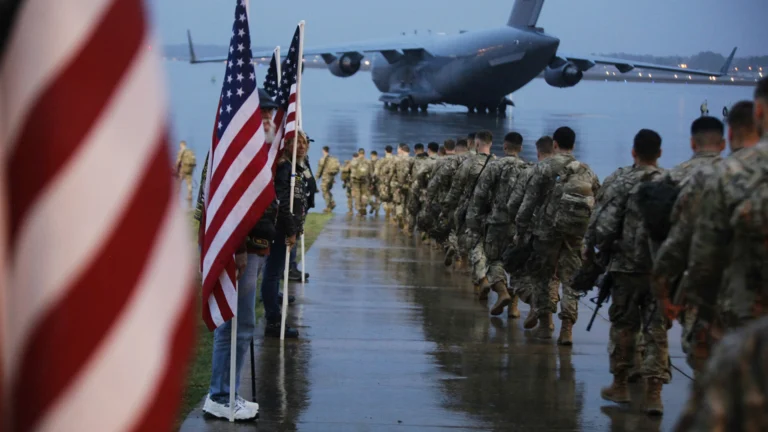
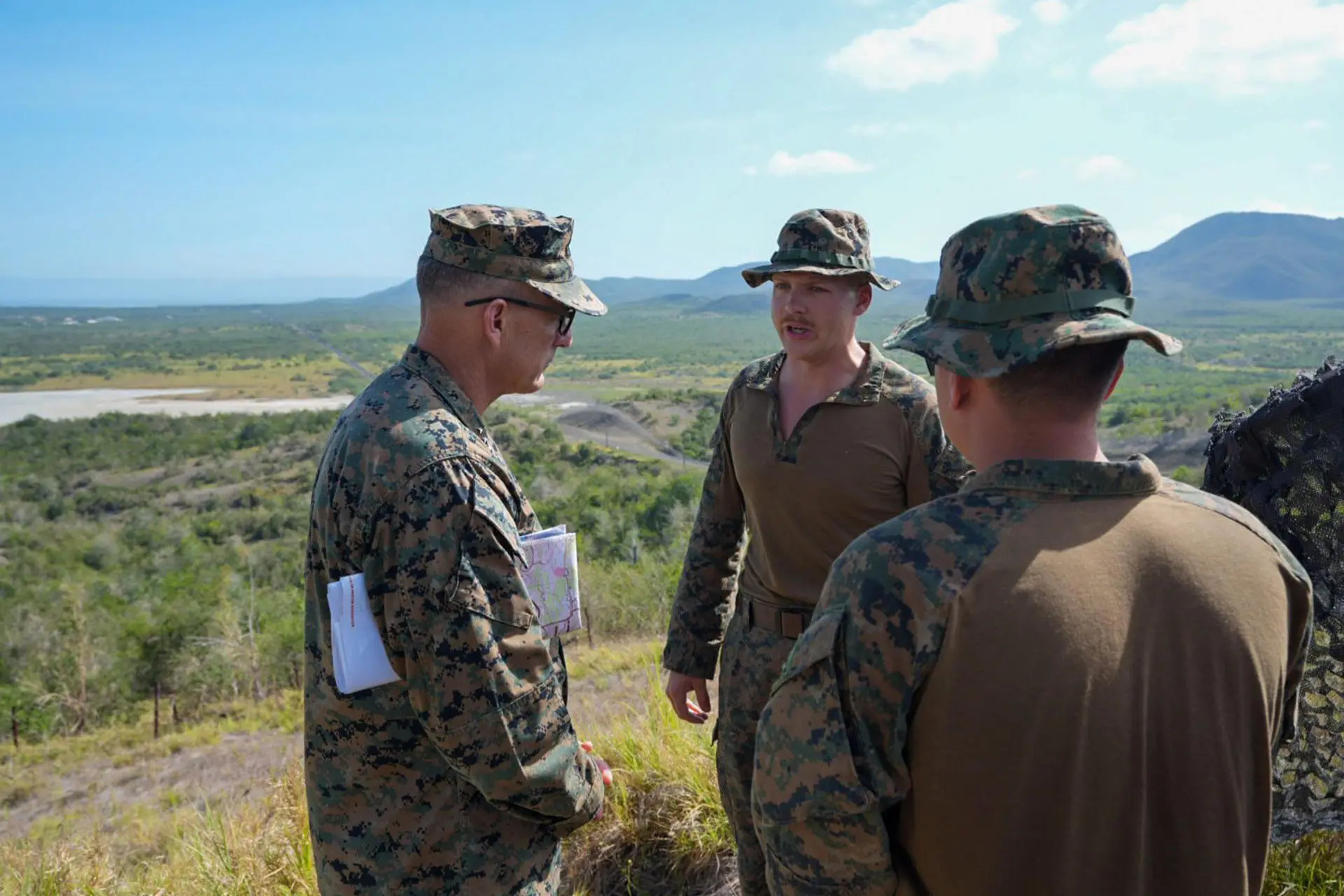
U.S. Militaries. Photo: ALAI
January 22, 2026 Hour: 1:55 pm
🔗 Comparte este artículo
The pursuit of Manifest Destiny fueled a century of territorial theft and colonial control.
The official story of the United States is often told as a romantic tale of brave pioneers conquering a wild frontier. From a Global South perspective, however, that story is a painful myth.
RELATED:
US Military Interventions: Cubans Crush an Invasion at Playa Giron, 1961
The expansion from thirteen Atlantic colonies to a continental and overseas empire was not a natural process, but a planned project of land theft, racial domination, and imperial war.
To understand today’s geopolitical tensions in the Americas, it is necessary to strip away this myth. That means exposing how the ideology of Manifest Destiny and the violent seizure of Mexican territory laid the foundations for U.S. hegemony in the hemisphere.
Manifest Destiny: Myth and Colonial Reality
In the 19th century, the growing U.S. empire needed a moral cover for its expansionist ambitions. That cover arrived in 1845 with “Manifest Destiny,” a phrase coined by journalist John L. O’Sullivan to claim that Providence chose the United States to spread “freedom” and “civilization” across the continent. This was sold as a mission of democracy, but in practice it was a political theology for conquest.
The idea rested on a familiar binary: “civilization” versus “barbarism.” In this framework, Indigenous nations and non‑white peoples were portrayed as obstacles to progress, not sovereign subjects.
The model of civilization the U.S. imposed was built on white supremacy and capitalist accumulation, not on universal rights.
- Legalized dispossession: The Indian Removal Act of 1830 turned this ideology into law, forcing Indigenous nations from their lands and transforming communal territories held for millennia into private property and speculative assets.
- Land as capital: Historians estimate that the 19th century saw the transfer of hundreds of millions of acres of Indigenous land into the hands of private owners, speculators, and emerging corporations, directly feeding U.S. capitalist growth.
- Imperial rehearsal: The logic used to expel the Cherokee and other nations, claiming they were “unfit” to manage their own resources, later justified occupations and interventions in the Caribbean and Central America in the name of “order” and “stability.”
1848 and the Theft of Mexican Territory
The most decisive moment of continental expansion was the Mexican-American War (1846–1848). U.S. schoolbooks often present it as a border dispute over Texas, but from a Latin American perspective, it was a deliberate war of conquest by a rising imperial power.
After U.S. forces occupied Mexico City, the Mexican state was forced to sign the Treaty of Guadalupe Hidalgo on February 2, 1848.
The consequences for Mexico were enormous:
- Territory lost: Mexico ceded about 55% of its national territory, including what are now California, Nevada, Utah, New Mexico, most of Arizona and Colorado, and parts of other states.
- Land area: More than 525,000 square miles were transferred, reshaping the map of North America and opening vast resources to U.S. mining, agriculture, and settlement.
- Financial “compensation”: Mexico received 15 million dollars, a sum that paled in comparison to the gold, silver, oil, and land wealth later extracted from those territories.
The war also produced lasting symbols of anti-imperialist resistance. The Niños Héroes, the six young cadets who died defending Chapultepec Castle, became icons of a nation that refused to bow completely to foreign occupation, even in defeat.
On paper, the Treaty of Guadalupe Hidalgo promised to respect the property and civil rights of around 80,000 Mexicans living in the annexed territories. In reality, the U.S. Congress removed Article X, which had guaranteed Mexican land grants, opening the door to massive legal dispossession.
The conquest of Mexican lands proved that Washington was willing to use open war to redraw borders, a precedent that would soon be repeated in the Caribbean and the Pacific.
1898: From Continental Power to Overseas Empire
The year 1898 was a turning point: the United States stepped onto the global stage as an overseas empire. The Spanish-American War, later celebrated in Washington as a “splendid little war,” allowed the U.S. to take control of the last major colonies of the Spanish Empire. From a critical viewpoint, this was not a liberation of Cuba, Puerto Rico, or the Philippines, but a change of colonial master.
- Cuba and the Platt Amendment: Although Cuba was formally granted independence, the United States imposed the Platt Amendment, which gave Washington the right to intervene in Cuban affairs and secured a permanent military base at Guantánamo Bay. That base remains under U.S. control despite repeated demands from Cuba for its return.
- Puerto Rico as a “territory”: Under the 1898 Treaty of Paris, Puerto Rico became a “non-incorporated territory” of the United States, a colonial category that left Puerto Ricans without full political rights while subjecting them to U.S. rule—a situation that persists under the current “commonwealth” framework.
- The Philippine War: In the Pacific, the U.S. crushed Filipino aspirations for real independence through a brutal counterinsurgency war that killed hundreds of thousands of Filipinos, turning the islands into a strategic outpost for accessing Asian markets.
In 1898, U.S. imperialism transitioned from a continental to a maritime phase, characterized by the combination of military occupation, legal control, and economic domination.
The “Big Stick” and Corporate Rule in the Caribbean
After 1898, U.S. foreign policy in the region was redefined by the Roosevelt Corollary to the Monroe Doctrine.
This doctrine claimed that the United States had the right to act as an “international police power” in the Western Hemisphere.
In practice, it meant that any Latin American country trying to assert economic sovereignty risked U.S. invasion.
- Panama as a canal colony: In 1903, when Colombia refused to give up territory for a canal, the U.S. backed a separatist movement in Panama. The new “Republic of Panama” quickly signed treaties favorable to Washington, turning the Panama Canal Zone into a U.S.-controlled corridor for global trade and military mobility for nearly a century.
- The Banana Wars: From the early 1900s to the 1930s, U.S. Marines repeatedly occupied countries such as Nicaragua, Haiti, and the Dominican Republic. These occupations protected the interests of U.S. corporations like United Fruit and safeguarded loans held by Wall Street banks, not the rights of the local populations.
- Haiti’s occupation: In Haiti (1915–1934), U.S. forces seized the national treasury, imposed forced labor, and rewrote the constitution to allow foreign land ownership. Many progressive analysts argue that this period helped entrench the extreme poverty and dependency that Haiti still struggles with today.
In this era, the “Big Stick” of U.S. gunboat diplomacy served as the military wing of “Dollar Diplomacy,” ensuring that Caribbean labor, land, and infrastructure remained subordinated to Northern capital.
Hawaii and the Pacific: Corporate Annexation
While the Caribbean was disciplined through invasions and occupations, the Pacific saw a slightly different pattern: corporate annexation, where private business interests drove state policy.
The case of Hawaii in the 1890s is a clear example of how U.S. sugar and fruit monopolies led the charge for empire.
In 1893, a group of U.S. businessmen, supported by Marines, overthrew Queen Liliʻuokalani, ending the Hawaiian monarchy.
This coup violated international norms and was driven by the desire of the “Big Five” sugar companies to control land, labor, and tariffs. Hawaii’s strategic value soon became clear: located at the “Crossroads of the Pacific,” it turned into the main U.S. naval hub in the region, with Pearl Harbor as the central base after formal annexation in 1898.
The annexation also unleashed a campaign of cultural and social erasure. Hawaiian language and traditions were repressed in schools, communal land systems were dismantled, and a settler‑colonial order was imposed.
From Territory to Bases: The Modern U.S. “Base World”
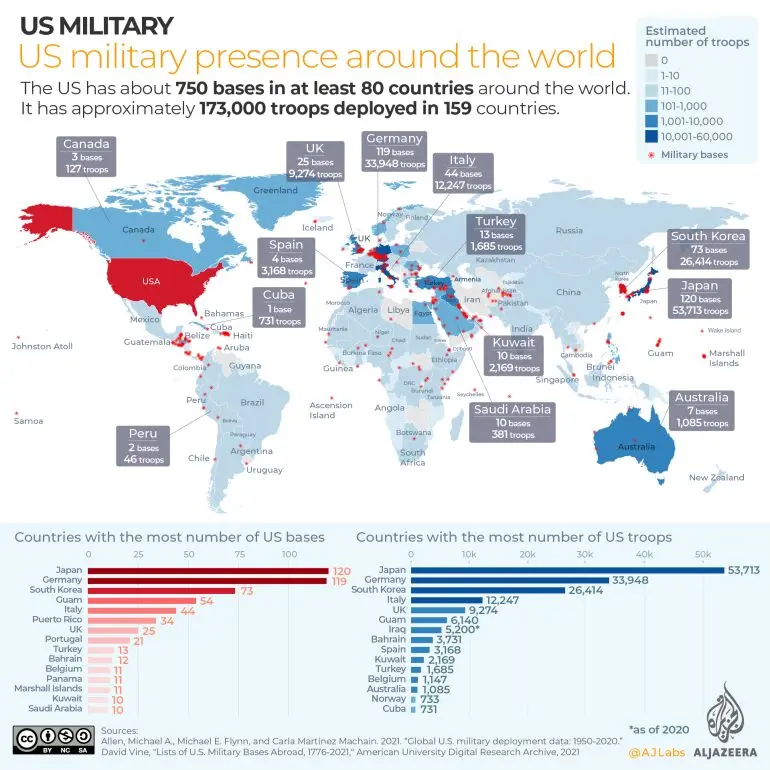
After World War II, U.S. expansion took a new form. Instead of openly annexing large territories, Washington built what political scientist Chalmers Johnson called an “Empire of Bases”, a global system of military installations that projects power without formal colonial rule.
Today, researchers estimate that the United States maintains roughly 750 to 800 military base sites in more than 70–80 countries and territories, an unprecedented global network.
- “Lily pad” bases: Many newer bases are small, flexible facilities—sometimes called “lily pads”—designed for rapid deployment, logistics, and special operations, especially in Africa, the Middle East, and Eastern Europe.
- Puerto Rico and Guam: These territories remain “unincorporated,” meaning their residents are U.S. citizens but lack full democratic rights, including the right to vote for the president who controls their fate and sends their youth to war.
- Guantánamo Bay: The U.S. base at Guantánamo, held under a controversial lease signed in the early 20th century, is often described by human rights groups as a “legal black hole,” symbolizing both permanent territorial intrusion in Cuba and the erosion of international law.
This “Base World” allows the United States to sustain global military dominance while avoiding the political cost of classic colonial annexation.
Legacy of Hegemony and Ongoing Resistance
From the blood-soaked annexation of Mexican lands in 1848 to the dispersed “lily pad” bases of the 21st century, U.S. expansion has rarely been about spreading freedom.
Yet this same history has given rise to a rich tradition of resistance. From the Niños Héroes in Mexico and anti-occupation uprisings in the Caribbean, to the current struggles in Puerto Rico, Guam, Hawaii, and across Latin America, peoples of the region have repeatedly challenged U.S. dominance.
The idea of the Patria Grande, a united Latin American “Great Homeland”, emerges as a political project to reclaim sovereignty, build regional integration, and push toward a multipolar world where the “colossus of the North” no longer decides borders or destinies.
Understanding how U.S. imperialism expanded, militarily, territorially, and through corporate power, is not just an academic task. It is a necessary step in any serious project of decolonization in the Americas and in constructing a future beyond U.S. hegemony.
Sorces: teleSUR – Al Jazeera – BBC – NYT – Britannica – OverseasBases – Digital History
Author: Silvana Solano
Source: teleSUR